It has been a while since I last documented my French experience. In the meantime, I finally received my Carte Vitale, my benefits kicked in, and for the first time, I could see the white light at the end of the long French bureaucratic tunnel.
Naturally, that is when I got a UTI.
If you are a woman, you already understand. Burning, urgency, discomfort, and a very limited tolerance for anything resembling human interaction.
You want one thing: a doctor, immediately.
So this was my moment. I had my French health card, I had access, and I was ready to experience the system. I walked into a primary care doctor’s office, sat down, and waited to be called. And then something unexpected happened.
In France, small talk is almost nonexistent. You can walk into a shop, say bonjour, and get a response that feels optional at best. People are not rude, just "economical with social energy".
Except in one place: the doctor’s waiting room. Every single person who walks in greets the entire room. Not casually, but deliberately. Bonjour, bonjour, bonjour. One person sits next to me and starts asking what brings me in.
Internally, I am thinking: I am here because I feel like I am about to die, I am one step away from peeing on a stick, and this is the exact moment you’ve decided we should bond. Also, where was this energy when I said bonjour to you in the store?
Eventually, the doctor comes out and calls my name herself. And that is where the real differences begin.
In the United States, a primary care visit is a sequence. You check in, hand over your insurance card, sometimes pay a co-pay upfront, then a medical assistant calls you back, takes your vitals, documents everything, and only after that do you see the physician. In France, there is no sequence. There is just the doctor.
No medical assistant. No nurse practitioner. No physician assistant. No layered staffing model.
The doctor is the system. The doctor is the intake, the triage, the diagnostics, and the treatment plan (at least in primary care).
The doctor is, quite literally, the rock star of the office. She brought me in, took my vitals herself, asked a few questions, and then casually suggested doing an ultrasound. Immediately. So I'm thinking ...I guess she is going to refer me somewhere BUT to my surprise...no referral, no scheduling, no separate department.
She simply got up, grabbed the machine, and performed the ultrasound on the spot to check my kidneys and bladder. This is where the difference becomes very clear. In the United States, imaging is a process. In France, at least in this setting, it can be part of the visit. After that, I was asked to do a urine test. The diagnosis of a mild UTI was confirmed, and I was given a prescription for antibiotics. Efficient. Direct. Done.
I walked out , said “Bonne Journée,” several more times to the room, and then left...without paying.




What stands out in the comparison:
First, the structure.
In the United States, care is distributed across multiple roles. In France, it is centralized. One physician manages the entire visit from start to finish.
Second, the staffing model.
The US system relies on multiple layers of clinical staff. In France, those layers are largely absent in routine primary care. The physician remains the central figure.
Third, access to diagnostics.
In the United States, tests and imaging often require referrals and additional appointments. In France, certain diagnostics may be performed immediately during the consultation.
Fourth, administration.
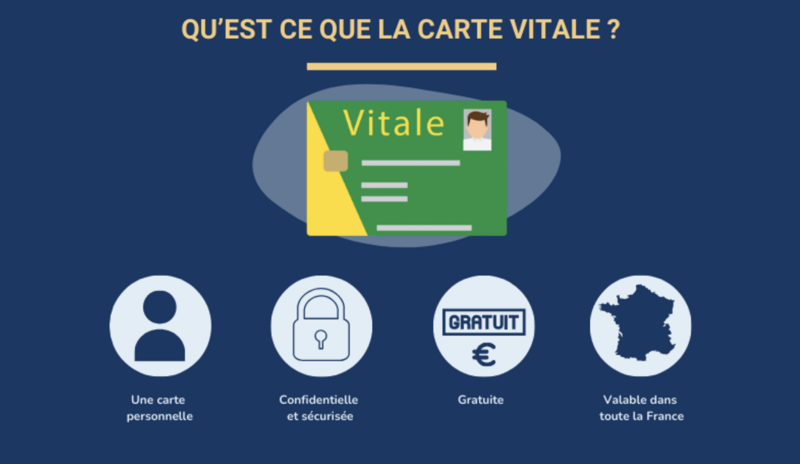
The Carte Vitale is a physical card with a magnetic strip. When you go to a doctor, whether in a private office, clinic, or hospital, they insert the card into a reader and access your entire medical records directly through the system.
Fifth, payment.
In the United States, healthcare operates through insurance with a co-pay system. Depending on your plan, you typically pay a co-pay at the visit, either at check-in or at check-out. For primary care, this might range from about $15 to $30, and more for specialty visits, depending on your insurance. In France, it is much simpler from the patient’s perspective. Assurance Maladie covers most of the cost of a primary care visit. There is no such thing as in network or out of network physician. For French and EU patients, the remaining amount is usually just a few euros, and in many cases, nothing at all.
What stayed with me was how quickly the whole thing was over. You walk in uncomfortable, slightly irritated, not really in the mood to talk to anyone, and then, within one visit, everything is handled. No back and forth, no extra steps, no wondering what comes next. You just leave. And at some point, on the way home, it hits you that something you would have stressed about, planned around, or even postponed was just… taken care of.